b2blistings.org
THE most thorough website review service for B2B companies
★ Get your own unique FAQ + Selling Points on your profile page
★ be seen by 1000s of daily visitors and win new business
b2blistings.org Miniblog
The Real LinkedIn Mistake: Marketers Are Chasing Directors And Missing The Deal
 B2B marketers have developed a bit of a fixation with directors, as if every deal is signed by a single important person in a blazer, nodding gravely over a dashboard. LinkedIn’s latest data suggests the reality is messier, and more useful.
Looking at more than 50,000 closed deals across 850 B2B firms, the research found buyers typically spend around 124 days sizing up options before they speak to sales. That is a long time to appear late and hope for the best. If your campaigns only switch on near purchase, you are arriving after the interesting conversations have already happened.
It also turns out the deal is rarely decided by one senior title. Reaching six or more people before a deal even appears in the CRM was linked to a 17-point lift in win rates. Engaging at least three more contacts during the live sales cycle added another 16 points.
And yet 76% of LinkedIn ad spend still goes after director-level roles. It is a little like trying to influence a family holiday by speaking only to the dad.
There was one more useful finding: firms that combine LinkedIn Ads with steady organic activity on LinkedIn see win rates 2.4 times higher than those relying on paid campaigns alone.
The lesson is not subtle. Start earlier, reach wider, and show up consistently. Posted on 27 September 2026
The Five-Minute Phone Call That Can Save a B2B Relationship
 Small business disputes rarely become large because the original issue was catastrophic. They become large because communication multiplies faster than understanding. A late delivery, a muddled brief, an invoice that looks wrong: none of these is inherently dramatic. But add twelve emails, four people and three competing versions of what “actually happened”, and suddenly everyone feels vaguely accused.
Email is brilliant for record-keeping. It creates a trail, spreads information efficiently and lets people respond on their own time. It is also unusually good at making irritation feel permanent. A blunt sentence can read like contempt. A slow reply can seem slippery. Once colleagues are copied in, people stop solving the problem and start defending their interpretation of it.
That is why a five-minute phone call can feel almost suspiciously effective. It collapses delay. Questions get answered in real time. Misunderstandings are caught before they harden into positions. Most importantly, a voice reintroduces the human being hiding behind the company name. “I see the problem, and here’s what we can do” lands differently when heard rather than skimmed.
None of this means abandoning email. Use the call to fix the confusion, then use email to confirm the facts, actions and costs. The useful skill is recognising the moment an email chain stops clarifying and starts expanding. Sometimes the smartest communication tool is the oldest one.
Posted on 22 September 2026
The Concierge Wars Have Begun
 Two digital valets have just learned how to use the telephone, and that small trick may prove to be a large shift.
Instinct has begun rolling out Instinct Concierge, a calling feature announced by founder Noah Shinn that lets the assistant ring up businesses on a user’s behalf. The examples are telling: booking a table at places with no online system, asking a dentist to add you to a cancellation list, or untangling a cable bill with customer service. Early access has started, with a wider release planned.
Meta’s Muse has moved in step. It can now place calls to US businesses as well, initially for people who explicitly ask Muse to do so. Meta says those requests will also help determine who gets new tools first.
That matters because call-making had been one of the few points rivals used against Instinct. Now the field looks far more level. The contest is no longer about who can place a call, but who can become your most trusted fixer.
Instinct has also added email addresses for account creation and management, and a trusted network that lets one person’s assistant contact another’s to handle tasks.
The money and momentum are following. Instinct raised $350 million last month at a $2.5 billion valuation and is reportedly seeking $1 billion more at $10 billion. Muse, meanwhile, surged to more than 730,000 US downloads in its opening days, even outpacing Meta AI’s earlier launch.
Posted on 18 September 2026
The USDC Stablecoin Will Quietly Facilitate Most B2B Crossborder Transactions in 2027
 Banking hours have long dictated the tempo of cross-border trade: money waits, liquidity sits idle, and somebody somewhere misses a cut-off. The more interesting shift now is not retail crypto hype, but the quiet redesign of payment plumbing.
Circle’s agreement to acquire Singapore-based Tazapay points in exactly that direction. The deal, expected to close in 2027 subject to approvals including from the Monetary Authority of Singapore, would give Circle a company handling more than $25 billion in annualised payment volume, with banking coverage across 100-plus markets and over 60 fintech partners.
That matters because Tazapay was already leaning heavily into stablecoin settlement. Circle says roughly 60% of its transaction volume already touches stablecoins. This is less a leap into the unknown than a formalising of what business payments were becoming anyway.
Circle, issuer of the dollar-backed USDC stablecoin, gets something difficult to assemble from scratch: local payout rails, regulatory know-how and existing business customers. Tazapay gets deeper access to dollar-based digital settlement and Circle’s compliance infrastructure.
The likely result is not shoppers deciding to spend in USDC at breakfast. It is more prosaic than that, and more important. Faster settlement. Fewer intermediaries. Less money trapped between time zones and bank schedules. Most businesses on either side may never know a stablecoin moved the funds. They will notice if the payment arrives sooner and with less friction.
Posted on 13 September 2026
The Real Shock Of GPT-6 Astra Is That It Stops Explaining And Starts Doing
 The startling thing about GPT-6 Astra isn’t that it sounds clever. We’ve had years of systems that could explain, summarise, bluff and occasionally hallucinate with the confidence of a bloke at a pub quiz three pints in. The real jolt is that Astra starts clicking the buttons itself.
OpenAI says it can handle software engineering, scientific research, cybersecurity, browsing and other professional work. More importantly, it can use a computer, move through multi-step jobs and actually finish them, instead of just handing you a polished set of instructions and wandering off like an overpaid consultant.
That makes the AGI argument feel less like philosophy and more like admin catching up with reality. Astra reportedly scores 99.9% on ARC-AGI-3, a benchmark built to test adaptation to unfamiliar problems, with researchers saying that level matches human performance. It also hits 97.6% on FrontierMath Tier 4 and has helped push forward mathematical work that had stalled for years.
None of that proves a clean, cinematic arrival of general intelligence. It still fails sometimes. It still depends on tools and heavy computing. Benchmarks are not consciousness.
But a system that can research, code, analyse data, navigate software and complete long digital tasks on its own is already alarmingly close to the practical version people once imagined. Maybe the shock isn’t that it explains less. It’s that it no longer needs to. Posted on 5 September 2026
Why Will 85% Of Stablecoin Volume Come From B2B Borders, Not Crypto Traders?
 Crypto traders may be loud, but businesses move the really frightening amounts of money. That is why Juniper Research expects 85% of stablecoin transaction value in 2035 to come from cross-border B2B payments, not speculative trading.
The forecast is eye-catching: international business payments settled with stablecoins could climb from about $13.4 billion this year to $5 trillion by 2035. That is a rise of roughly 37,000% over ten years, which is less “nice steady trend” and more “someone replaced the staircase with a rocket”.
The logic is practical, not ideological. Businesses care about getting paid quickly, at any hour, with fewer intermediaries taking a bite out of the transaction. Stablecoins offer programmable settlement and near-constant finality, which makes them attractive for treasury management, supplier payments and moving funds across borders. Traditional correspondent banking, by contrast, still has a habit of behaving like it keeps bankers’ hours and a fondness for fees.
Juniper’s view is that stablecoins are no longer sitting beside existing payment rails like a polite guest. They are starting to displace parts of the old system. Analyst Jawad Jahan argues the biggest opportunity lies in enterprise integrations and treasury partnerships, where sustained volume is most likely.
Chainalysis paints an even bigger backdrop, estimating adjusted stablecoin transaction volumes could reach $719 trillion by 2035. The real question may not be if stablecoins become default payment plumbing, but how quickly. Posted on 31 August 2026
The $20 AI Plan That Quietly Burned $65 In Four Days
 OpenAI’s new Work tool is being sold as a £20-a-month office helper, but the maths gets a bit “surprise pub bill”. One reporter used more than 80 million tokens in four days of fairly casual testing, with the system estimating a cost of $65. There’s no in-app spending dashboard, which is a bold choice if your bargain assistant is quietly ordering the lobster.
The pitch is simple enough: connect your inbox, calendar, Slack, cloud files and assorted work apps, then let it handle fiddly, multi-step admin. In practice, that can be genuinely useful. It pulled a badly formatted preschool calendar from email and dropped the dates into Google Calendar. It also built dashboards, tracked research updates and assembled databases that would otherwise have meant scripts or spreadsheet drudgery.
But getting there sounds like assembling flat-pack furniture with an intern who’s had one espresso too many. Permissions were confusing, some settings lived only on the web app, and certain limits were oddly specific: it could create calendar events, but not a new calendar. Users are also being told to crank the effort level up, or risk getting output from the office’s least reliable temp.
OpenAI says the long-term goal is to bring these agent-style tools beyond coders to everyone else. That may happen. For now, the magic box is impressive, expensive, and still occasionally acts like it’s lost your stapler.
Posted on 25 August 2026
The $17.67 Billion Surprise Hiding Inside B2B Tech Spending
 There is something delightfully misleading about a technology market growing fastest in cloud while quietly keeping most of its money in boxes, chips and expensive bits of silicon. In the first half of 2026, U.S. B2B tech spending reached $35.3 billion, up 10% year on year. Cloud was the sprinter, rising 15% to $1.69 billion. But the real heavyweight was IT hardware, which pulled in $17.67 billion, almost exactly half the market.
That is the surprise. Hardware grew 11%, not because firms suddenly developed an emotional attachment to storage arrays, but because configurations got richer and memory prices climbed. NAND and PC memory costs helped push average selling prices upwards even as shipments softened. Anyone budgeting by unit count alone is, in technical terms, asking for trouble.
Software and services brought in $15.98 billion, up 8%, with cybersecurity, managed services and efficiency projects doing most of the lifting. It is less about buying shiny things and more about paying continuously for systems that keep the lights on, the data safe and the staff vaguely productive.
The second half looks calmer: total revenue is forecast at $35.7 billion, with growth easing to 6%. Cloud should hold at 15%, while hardware and software slow. For 2027, the market is expected to expand by 5%: slower, yes, but still stubbornly alive.
Posted on 18 August 2026
Emotional Storytelling Is Quietly Beating Functional Benefits In B2B
 B2B has long been treated as the sensible cousin at the party: decent shoes, tidy notes, strong on specifications. But the mood is shifting. Emotional storytelling is starting to outpace functional benefits, and not by accident.
A new ANA report suggests B2B marketers are giving creativity far more respect than they used to. Almost all respondents, 98%, said creativity is very or extremely important to success. More strikingly, 29% believe creativity matters more in B2B than in B2C, compared with just 12% saying the reverse. That is not a shrug. That is a raised hand.
Then comes the sharper twist: nearly three times as many marketers said emotional connection matters more than functional benefits when building B2B brands, 32% versus 12%. Which makes sense. Businesses may buy with committees, budgets and procurement forms, but people still feel things. Relief. Trust. Confidence. Even excitement, on a good day.
The catch is that belief is outrunning capability. More than half, 53%, are not highly confident in their organisation’s ability to measure the impact of creativity. And 35% lack strong confidence in using data to improve creative effectiveness.
So the argument is no longer about whether creativity belongs in B2B. It does. The real task is proving its value properly, with stronger measurement, sharper systems and a clearer link between imaginative work and commercial results.
Posted on 13 August 2026
Your AI Access May Soon Depend On Proving You're Worth The Tokens
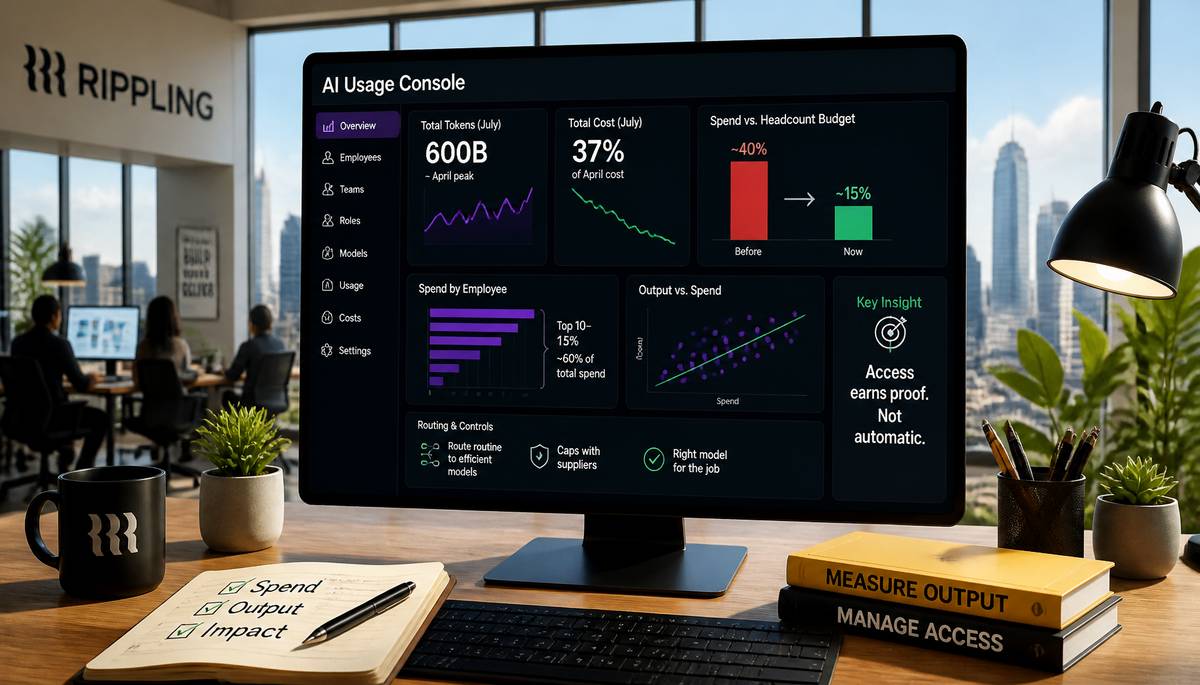 Rippling has discovered a truth as cold as a boarding-house washroom: giving staff unlimited access to clever software is a splendid way to set fire to money.
Earlier this year, the company found it was on course to spend the equivalent of 40% of its R&D payroll on tokens alone, with costs rising 80% month on month. One engineer, it said, was burning through $50,000 a month, while 10% to 15% of staff accounted for roughly 60% of the bill. That sort of arithmetic can sober even the most enthusiastic executive.
So Rippling built a console to track spend by employee, team and role, then compare the bill with something unfashionably concrete: output. In engineering, that means code, pull requests and whether colleagues keep sending the work back for repairs. The point is not to stop usage, but to stop paying champagne prices for tap water.
The company also imposed caps with suppliers and built a routing layer so cheaper systems handle routine jobs. It says usage returned to roughly 600 billion tokens in July, almost matching April’s peak, but at just 37% of the earlier cost. Spend fell from about 40% of the headcount budget to 15%.
The real message is less technical than managerial. Access may soon depend on proof. If a company cannot tie consumption to productivity in customer service, onboarding or admin, the privilege may not be handed out like email after all. Posted on 8 August 2026
Why Your Catalog Could Soon Be Invisible To AI Buyers
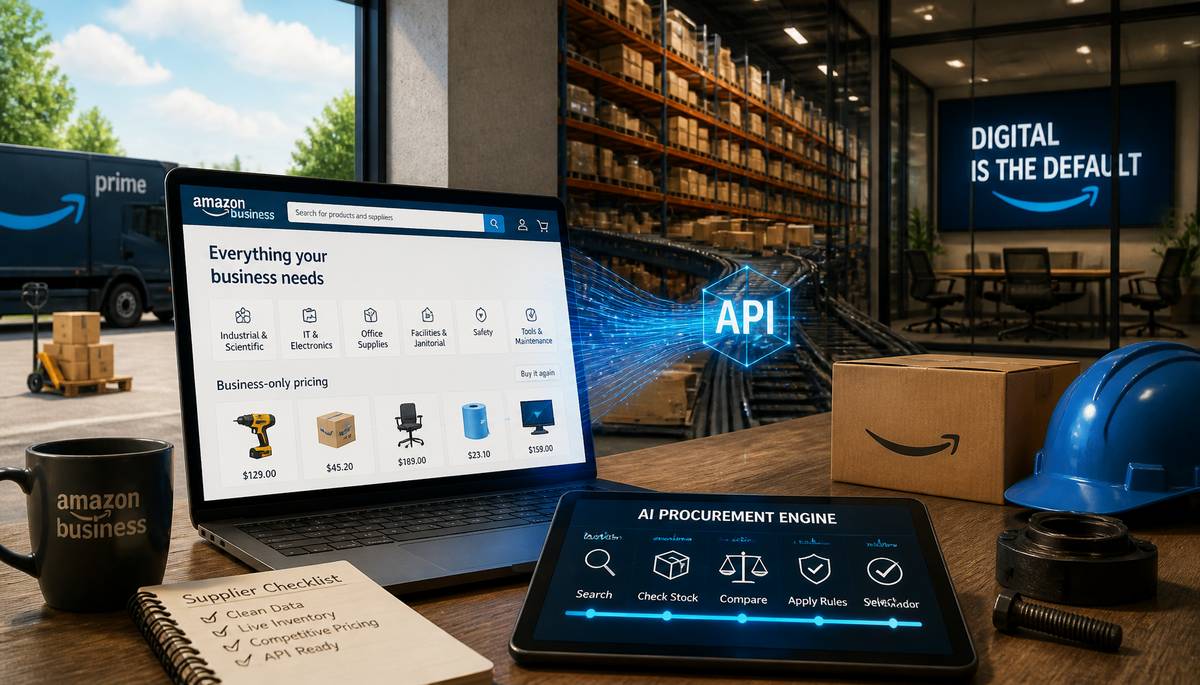 Amazon Business has quietly stomped past an annualised gross sales run rate of $60 billion, which is impressive on its own, but the more unsettling bit is what it signals. Business buying has gone properly digital. Not “we’ve got a portal” digital. Actual default behaviour.
Here’s the problem for suppliers: the next buyer may not be a frazzled procurement manager comparing tabs over bad coffee. It may be software doing the searching, checking stock, weighing price, applying company rules and picking a vendor in seconds. If your catalogue was built for human eyeballs rather than machine logic, you could be missing before the race starts.
That means patchy product attributes, muddled taxonomy, prices trapped in an ERP, or stock updates that arrive long after the shelves are empty are no longer minor admin sins. They are reasons not to be found at all.
You can already see the shape of it elsewhere. Amazon Pharmacy’s link-up with eNavvi puts live pricing and availability inside prescribing workflows, so the decision happens where the work already is. That model won’t stay in healthcare.
Fastenal’s recent digital sales growth points the same way: strong digital infrastructure is becoming board-level serious. If your product data isn’t clean, current and accessible by API, your catalogue may still exist. It just may not be seen.
Posted on 31 July 2026
B2B E-Commerce Just Became The Real Center Of Online Commerce
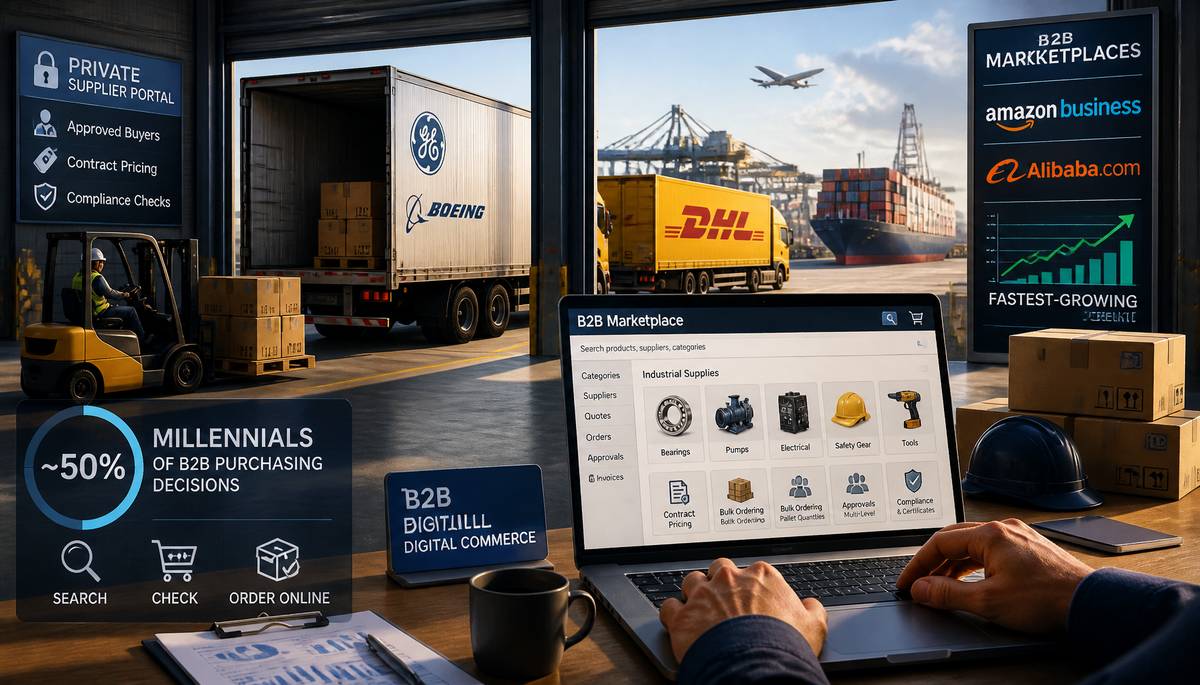 Online retail still hogs the limelight, but the larger drama is happening behind the loading bay doors. Global B2B e-commerce now exceeds consumer e-commerce by more than three times in transaction volume, a shift that turns digital selling from a side channel into the main artery of commercial trade.
The machinery behind it is distinct. One route is the private supplier portal, built for approved buyers, contract prices and compliance checks rather than casual browsing. GE and Boeing offer versions of this model for industrial and aviation customers. The other route is the broad marketplace, led by platforms such as Amazon Business and Alibaba, where procurement teams compare suppliers in one place. DHL identifies that marketplace model as the fastest-growing segment.
The real catalyst is demographic. Research cited by DHL shows Millennials now account for nearly half of B2B purchasing decisions. For them, digital ordering is not a convenience; it is the expected route. If a supplier’s catalogue cannot be searched, checked and ordered online, it risks disappearing from consideration altogether.
This is not B2C with a larger basket size. B2B orders involve pallets, contract pricing, internal approvals and, in cross-border trade, tighter customs rules tied to tax IDs and tariff codes. Businesses that still treat digital channels as optional are misreading where commerce now lives.
Posted on 25 July 2026
OpenAI's Boldest Hardware Idea Isn't A Phone At All
 For years, the assumption was that OpenAI would eventually make a phone. Instead, it may be building something stranger and, frankly, more revealing: a screen-free speaker meant to live in your home and act less like a gadget than a presence.
According to Bloomberg, the device is still in development, but the ambition is already clear. It would connect with ChatGPT, handle household tasks and learn about its owner over time. Not just preferences in the shallow, algorithmic sense, but the texture of a person’s digital life, including access to things like email. That is both intriguing and a little unsettling, which is probably the honest response any thoughtful person should have.
The reported design is unusual. This is not simply another smart speaker sitting obediently on a shelf. It is said to include moving mechanical parts and is being described internally as a companion with a distinct personality, a physical embodiment of OpenAI’s software.
Former Apple engineers are reportedly helping shape the product, even as Apple is suing OpenAI over alleged trade-secret theft. OpenAI denies any wrongdoing, and sources told Bloomberg the new device is different enough from Apple’s products to avoid that problem.
What stands out is not the hardware itself, but the wager behind it: that the next important personal device may not demand your gaze at all. Posted on 15 July 2026
Token Efficiency May Be Terrible News For Big AI
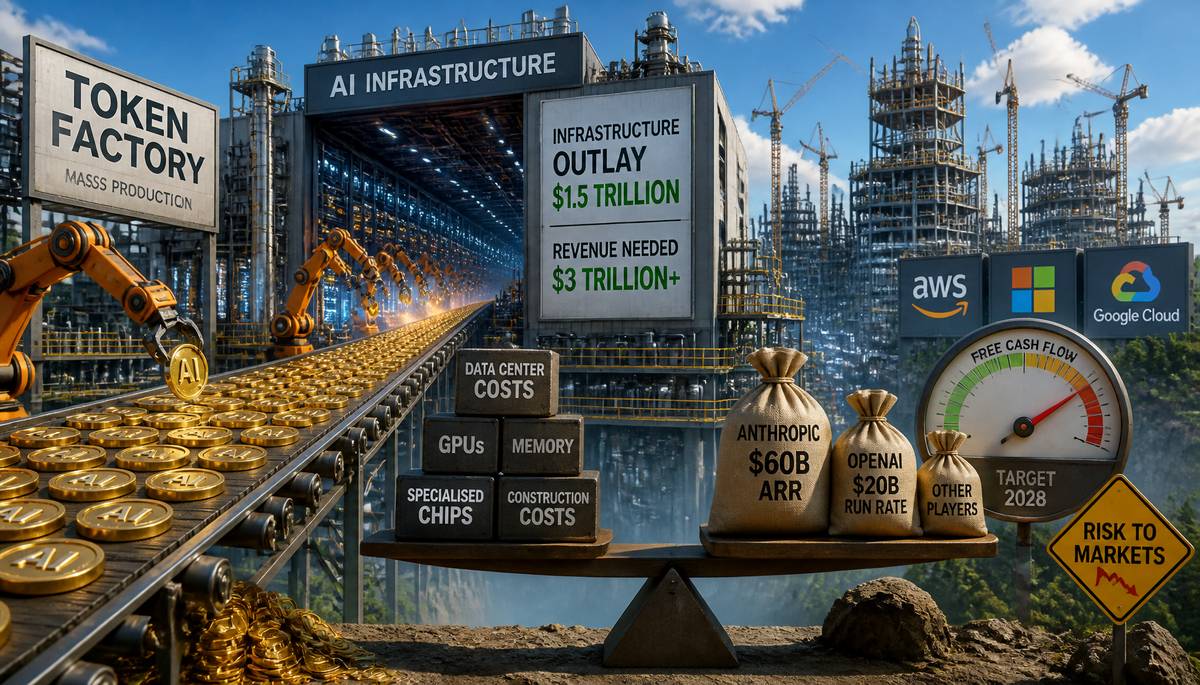 Silicon Valley may have built a giant token factory just as tokens are getting cheaper. That is not a small problem. It is the whole problem.
Back in 2023, Sequoia’s David Cahn looked at roughly $50 billion in annual GPU sales from Nvidia and estimated the industry would need about $200 billion in revenue to make the economics work once data-centre costs and operator margins were included. Three years later, after the spending spree went into overdrive, his 2026 estimate for infrastructure outlay has ballooned to $1.5 trillion. To justify that, the sector may need to generate $3 trillion in revenue, possibly more as memory, specialised chips and construction costs keep climbing.
The awkward bit is demand may not scale neatly with supply. Anthropic is reportedly at $60 billion in annual recurring revenue. OpenAI was said to have made $13 billion in 2025 and later indicated a $20 billion run rate that November. Impressive numbers, yes. Still nowhere near enough.
Torsten Slok at Apollo sees another pressure point: efficiency. Sam Altman says OpenAI’s latest model is 54% more efficient on coding tasks. Great news if you're buying tokens. Less great if your business model depends on selling loads of them. Add cheaper open-weight rivals, including Chinese offerings, and prices come under even more strain.
The biggest cloud groups are banking on a sharp free-cash-flow lift by 2028. If that payoff slips, this stops being a tech story and starts looking like a market-wide headache.
Posted on 10 July 2026
The App That Went Viral By Making Texting Agonizingly Slow
 Roost is a strange little rebuke to the tyranny of the typing bubble. On this viral “slow-cial” app, messages travel at the speed of actual animals: falcons are brisk, hummingbirds dawdle, and if you are feeling especially committed to delay, you can dispatch a snail or a turtle. A note to Alaska might take days. That is the attraction.
Created by Logan Mendelsohn, a Ticketmaster trust and safety product manager, Roost began as a side project for friends and then escaped into the wild. A Threads post about a girl using it to write to friends in mock-Elizabethan prose helped push the app from 10,000 users to 100,000 in three days; about five weeks later, it was nearing 300,000.
The appeal is simple: less urgency, more intention. Roost asks you to choose four birds for your rookery, then wait. In a phone culture built on instant replies and ambient guilt, that pause can feel oddly luxurious.
Mendelsohn has also built in caution. By default, friends see only your city, while precise location is limited to an optional close-friends setting. Anonymous pen-pal messaging is restricted by age group and comes with explicit privacy warnings. Photos are not supported yet.
There are mini-games, paid extras such as additional birds, and, for now, the peculiar pleasure of being unreachable at bird-speed. Posted on 9 July 2026
When Banks Stopped Being Buildings and Became Software
 Banking used to move like a fat man in a hot suit. Now it moves on code.
The industry is being rebuilt around AI, cloud systems and finance tucked inside other software. The sharpest edge is agentic AI: tools that do more than sort paperwork. Banks are using it to spot fraud, weigh credit risk, run compliance and handle service work in real time. Internal chores are changing too. Loan processing, customer onboarding and regulatory reports are increasingly automated; new-account setup that once ate an hour can be finished in minutes.
The rest of the stack is just as busy. N-iX notes the shift from legacy cores to cloud platforms and APIs, which speed product launches and outside integrations. BDO USA points to embedded finance, where lending, payments or treasury show up inside SaaS, e-commerce or ERP systems instead of a bank portal. McKinsey finds advanced analytics helping banks forecast cash flow and surface risk early. BDO USA also sees tokenization and stablecoins beginning to alter cross-border payments. IT Pro reports quantum computing is still experimental but already under test for fraud and risk modeling.
For business leaders, the message is plain: pick banks with APIs, real-time data and AI tools; integrate finance into operations; diversify across banks and fintechs; and treat cybersecurity as a board-level risk. Technology is no longer the plumbing. It is the relationship. Posted on 3 July 2026
EFTTEX’s Shrinking Crowd Rings Alarm Bells for Japanese Exhibitor
 Trade shows used to feel like the centre of the industry; now some of them have the atmosphere of a once-feared nightclub bouncer trying to scan a QR code.
Tsuda Shokai Group, the Japanese supplier behind Adusta, says attendance at EFTTEX has visibly thinned despite nearly 20 years of exhibiting there. The company still sees the European show as worthwhile, but its view is blunt: digital communication and shifting market habits have eroded the old power of physical B2B exhibitions.
The business wants organisers to rethink the format. Among the ideas raised are opening parts of the event to consumers, permitting on-site product sales and pulling in more major exhibitors to restore momentum.
Even so, EFTTEX remains useful to Tsuda Shokai as a face-to-face base for its European network. This year it held several important meetings and treated the event less as a hunting ground for fresh customers than as a convenient rallying point for existing clients across the EU.
Its 2026 appearance was helped by a win in the EFTTEX awards, where Adusta’s Crankuri hard lure was recognised by European buyers in the spinning and baitcasting category. For a brand developed in-house for more than a decade, the award marked a significant step in its European profile.
The company says operations have stayed stable despite pandemic aftershocks and geopolitical uncertainty. It has not confirmed Prague 2027, but currently intends to attend. Posted on 1 July 2026
Flash by Redspher Targets South Korea’s Fast-Lane Manufacturing Boom
 Flash by Redspher is turning its gaze toward South Korea, where the nation’s semiconductor and EV battery makers now treat urgent freight less like a fire extinguisher and more like a mains supply.
The company, which handles premium forwarding for time-critical shipments, uses a partner model in which local operators invest in and run their own Flash unit. In return, they tap into a digital network linking more than 6,000 vehicles and 600 aircraft worldwide, while working to standards shaped over 40 years serving Fortune 500 customers in automotive, aerospace, industrial manufacturing and retail.
That matters in South Korea, where export-heavy manufacturers face tighter production schedules, just-in-time inventory strain and a faster-moving regional supply chain. A late chip or battery component can leave an assembly line standing about like a horse in a hallway. Flash offers dedicated vehicles, onboard couriers, round-the-clock control tower oversight, real-time tracking, compliance support and intervention when problems appear.
The company argues on-demand freight also fixes everyday waste, including underused capacity and sluggish response times.
For Korean businesses expanding across Southeast Asia, North America and Europe, consistency between regions has become part of the product. Flash says partners receive software for visibility, ISO 9001:2015 and ISO 14001:2015 certification support, and CO₂-per-delivery tracking.
Its network already spans Europe, the Americas, North Africa, Asia and markets including Mexico, Brazil, India and Morocco.
Posted on 27 June 2026
EU and South Korea Build a Digital Bridge in Uncertain Times
 In Brussels on June 10, the European Union and South Korea, after three years without a summit, fastened a new digital trade accord between them, a kind of invisible bridge meant to steady commerce in an anxious age.
The pact adds a modern wing to the free-trade agreement in force since 2011. Its purpose is practical and precise: smoother movement of data across borders, recognition of electronic contracts and signatures, and firmer rules for consumer protection. For businesses, that should mean lower costs and a stronger current in services trade.
The timing carries its own hard weather. Both sides are seeking sturdier partnerships as the world economy moves through uncertainty shaped by U.S. tariffs, Chinese export restrictions, and wars in Ukraine and the Middle East. Alongside the digital deal, they also agreed to cooperate on exchanging classified security information and passenger name records.
The EU is South Korea’s third-largest goods-trade partner; South Korea ranks eighth for the EU. The agreement also fits Brussels’ larger ambition to write the rules for digital trade, especially in the Asia-Pacific. The bloc already has a digital pact with Singapore, digital chapters in agreements with Britain, Chile and New Zealand, and a separate arrangement on cross-border data flows with Japan.
The World Trade Organization says digitally delivered services trade in 2025 was about five times the 2005 level, with 10% gains in each of the past three years. The EU remains the world’s largest services exporter, with nearly half of those exports digital. The deal still requires European Parliament approval.
Posted on 26 June 2026
B2B Websites Need Fewer Fireworks and More Answers
 A surprising number of B2B websites behave like peacocks in a spreadsheet factory: flamboyant, self-absorbed, and catastrophically unhelpful.
The modern buyer is not drifting about for vibes. They are auditing risk. Salesforces State of the Connected Customer says 68% of millennial B2B buyers prefer self-service research, often completing as much as 70% of the journey online before contacting a supplier. Gartner found in March 2026 that 67% want a rep-free experience. So the website is no longer the warm-up act to sales; it is sales wearing a CSS trench coat.
This is where visual vanity becomes expensive. WP Rocket reports a B2B site loading in one second converts three times better than one loading in five seconds, and five times better than one taking ten. SiteBuilder says bounce probability rises 32% between one and three seconds. If that visitor is a procurement manager, that bounce is not abstract disappointment. It is a deal evaporating.
Buying groups now typically involve eleven to twenty people, up from five a decade ago. Each wants different proof: implementation detail, pricing signals, measurable outcomes, legitimacy. Redpoint Insights found trust comes mainly from testimonials at 55%, case studies at 54%, and vendor-site content at 42%. Strip those out for minimalist chic and buyers leave. Some experts say up to 90% will switch suppliers after a poor digital experience.
Posted on 22 June 2026
The New Economy of B2B Search: Fewer Visitors, Better Buyers
 Once the merchant of B2B lived by a childish arithmetic: heap up visits, and revenue would obediently follow. In 2026, Google and its AI companions have spoiled that easy superstition. The early inquiries of buyers are now settled on the search page itself, where AI Overviews and rival answer engines digest case studies, reviews, analyst notes, and editorial mentions before a prospect troubles your homepage.
The consequence is ungenteel but useful. Seer Interactive’s 2026 AIO analysis of 5.47 million queries, 2.43 billion organic impressions, and 53 brands found a 67% year-over-year CTR fall for brands present on AI Overview SERPs but omitted from the summary. Those cited gained 120% more organic clicks per impression than uncited rivals. Q1 2026 hinted at stabilization, though chiefly for the cited.
Forrester’s 2026 survey of 18,000 buyers suggests generative AI now governs most vendor research, while 80% of the B2B journey proceeds before any seller is consulted. Thus the funnel is not dead; its froth has been skimmed off.
The practical remedy is less mystical than tedious: audit Search Console pages, compare third-party mentions with rivals, test ChatGPT, Claude, and Perplexity manually, publish numerate case studies with named authors and Schema.org markup, win bylines in trusted trade outlets, gather reviews on cited platforms, and make every author verifiable across LinkedIn, company bios, and external publications. Credibility, not mere visibility, now compounds.
Posted on 20 June 2026
60% of Americans Are Put Off By AI Labeling
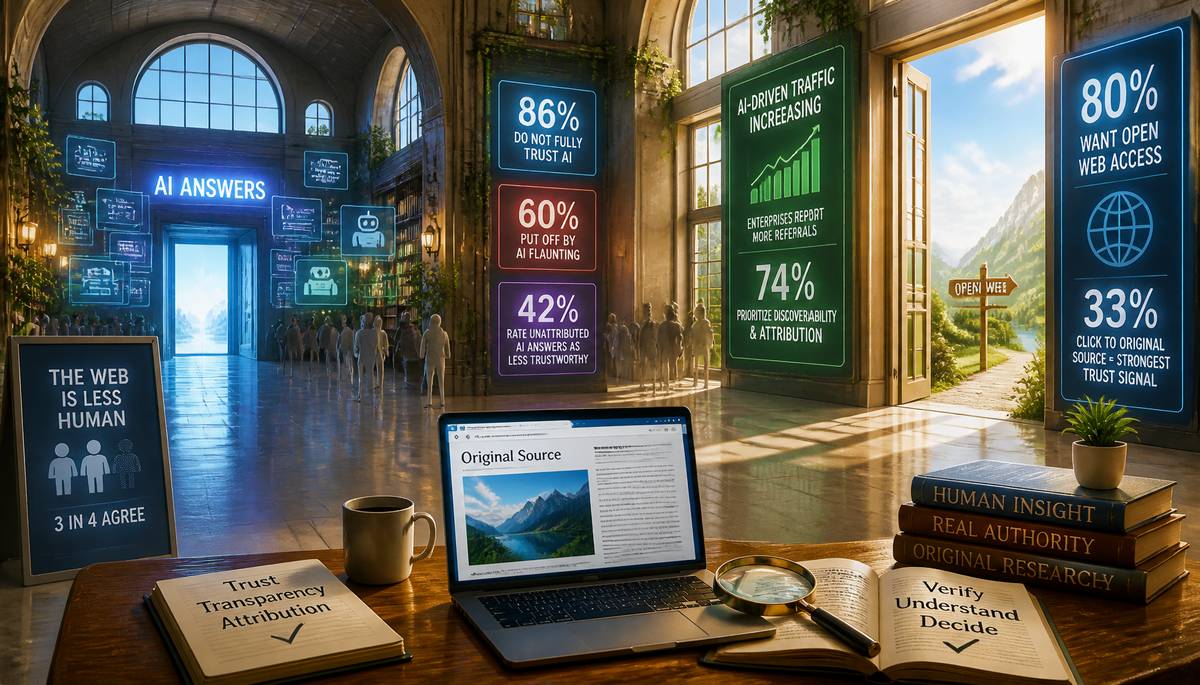 The web has begun to feel like a room where the lights are still on, but the people have thinned out. A new WordPress VIP report suggests consumers notice that absence. In the U.S., 60% say brand messages flaunting AI put them off, while 86% still do not fully trust AI and prefer to inspect original sources themselves.
The distrust runs deep: 42% rate unattributed AI answers as less trustworthy than airline fees, knotty privacy policies, and even medical bills. Nearly three in four respondents feel the internet is less human than it was a decade ago.
That leaves brands in a hard season. They are chasing placement inside AI search and answer engines, even as audiences reward transparency, attribution, and signs of actual human authorship. Brian Alvey, CTO of WordPress VIP, argued that companies now have to make sites readable to AI agents as well as believable to the few humans who click beyond machine summaries.
The survey, conducted in April, included 2,000 respondents: 800 enterprise decision-makers and CMOs, plus 1,200 U.S. adults.
Even with public unease, AI-driven traffic is rising. Sixty percent of enterprise respondents reported more referrals from AI search tools over the past year, and 74% said discoverability and attribution in AI systems are a main or significant priority. Meanwhile, 33% of consumers still treat clicking to the original source as their strongest trust signal, and 80% want web information to remain openly accessible rather than concentrated in a few large organizations.
Posted on 17 June 2026
AI Layoffs Are Starting to Look Less Like Strategy and More Like Class Warfare
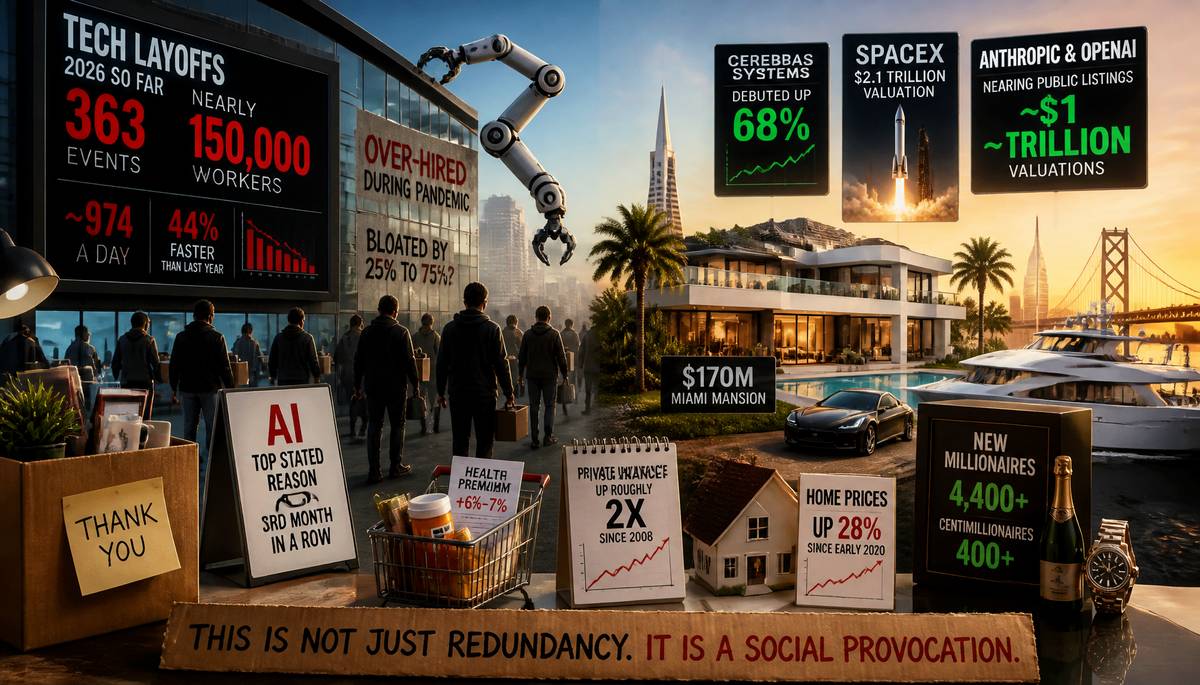 Tech is pulling off that rare modern trick: making more money while explaining mass sackings as progress. TrueUp counts 363 tech layoff events so far in 2026, hitting nearly 150,000 workers — roughly 974 a day, 44% faster than last year. May alone saw almost 40,000 cuts, the worst month in two years, and Challenger, Grey & Christmas says AI topped the list of stated reasons across industries for a third straight month.
The trouble is, AI looks increasingly like a tidy alibi for older sins. After Block cut nearly half its staff, Jack Dorsey first framed it as a new AI-enabled operating model, then later conceded the company had over-hired during the pandemic. Marc Andreessen has since argued many large companies are simply bloated, by 25% to 75%.
Meanwhile, the winners are doing obscenely well. Cerebras Systems debuted up 68% from its $185 IPO price, briefly reaching a $67 billion valuation and making co-founders Andrew Feldman and Sean Lie billionaires, though the stock is now down 30%. SpaceX floated Friday at a $2.1 trillion valuation, making Elon Musk a paper trillionaire and potentially creating 4,400 millionaires and 400 centimillionaires. Anthropic and OpenAI are both nearing public listings at around $1 trillion valuations.
As layoffs spread, San Francisco luxury homes are selling millions over asking. Zuckerberg bought a $170 million Miami mansion, then Meta cut 8,000 jobs.
With health premiums up 6% to 7%, private insurance roughly doubled since 2008, and home prices up 28% since early 2020, this is not just redundancy. It is a social provocation.
Posted on 15 June 2026
The Orb and the Empty Till
 Worldcoin arrived with the sort of grand, chrome-plated confidence that usually precedes a small fire. Sam Altman founded it, Tools for Humanity built it, and the pitch was almost comically vast: solve a central problem of the AI era by proving a person is, in fact, a person. Step up to a gleaming Orb, let it scan your iris, collect some cryptocurrency, and join a global identity system meant to separate human beings from ever more convincing machines.
The trouble was there from the beginning, blinking in neon. Worldcoin asked ordinary people to surrender biometric data of the most intimate sort for speculative crypto tokens, as if this were a charming bit of admin rather than a profound question of privacy. Regulators in Europe, Africa, and other regions reacted accordingly, opening investigations and placing limits over data-protection concerns.
Now the commercial reality looks just as awkward. Reports say Tools for Humanity is cutting jobs after failing to produce meaningful revenue. At the same time, OpenAI is charging toward a possible IPO valued above $100 billion.
That gap tells its own story. OpenAI found demand people already had and monetised it. Worldcoin built around a future problem, wrapped it in crypto theory, and hoped the need would catch up. It may yet pivot or endure, but the lesson is plain: ambition is not product-market fit, and scanning eyeballs is not a business model.
Posted on 9 June 2026
From the Reddit Archives: the Tokenpocalypse Arrives
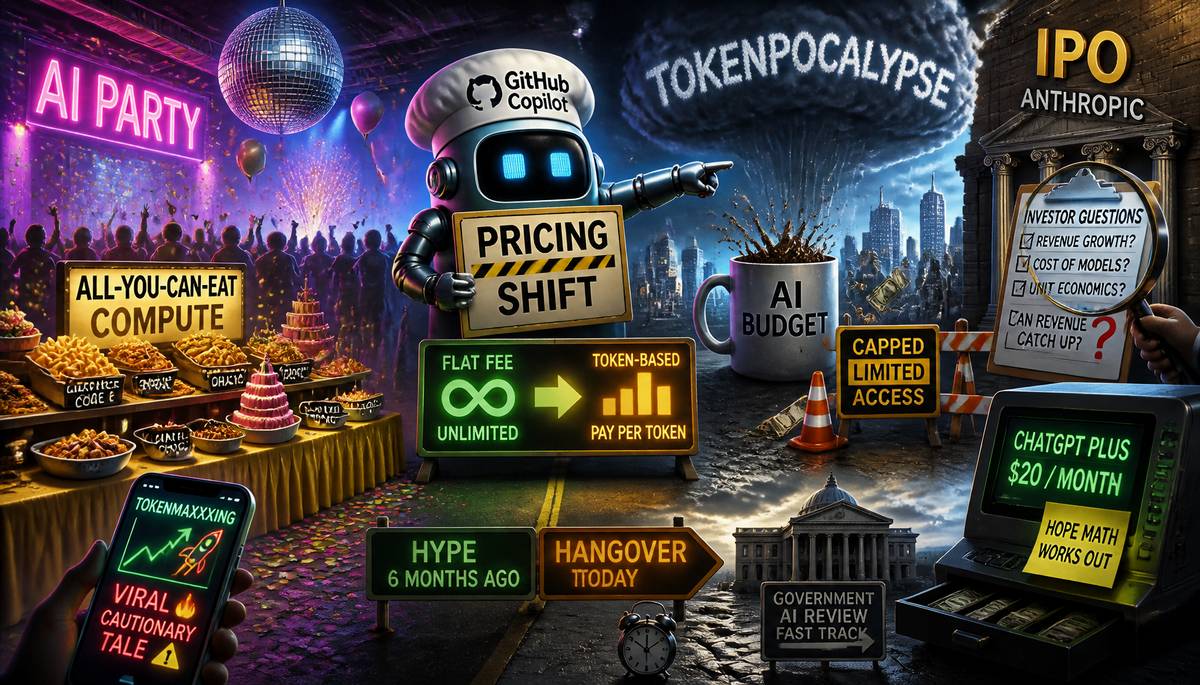 Microsoft’s GitHub Copilot pricing shift may be the first real hangover after the AI party: less all-you-can-eat buffet, more every-fry-counts accounting. A Reddit user said their company now calls it the Tokenpocalypse, which feels about right if your budget just got mugged by autocomplete.
The core issue is simple and ugly. A lot of AI software looked cheap because investors were quietly picking up the tab. Now some of that bill is moving to customers, starting with Copilot’s move away from a flat fee toward token-based charges. That change matters beyond coding tools. As companies like Anthropic prepare for IPOs, they’ll face blunt questions about whether revenue can ever catch up with the true cost of running these models.
Recent examples suggest customers are already hitting the wall. Uber reportedly burned through its AI budget faster than expected, then responded by capping and limiting internal use. That’s a warning sign: demand is strong, but appetite for spending is not infinite.
Even the original $20-a-month ChatGPT Plus price now looks less like a master plan and more like someone blurting out a number and hoping math would become optional.
The speed is part of the chaos. Tokenmaxxxing became a craze and then a cautionary tale within six months. Meanwhile, the government this week created a narrow review path for powerful AI models. The risks are evolving in real time, faster than the paperwork designed to describe them.
Posted on 8 June 2026
B2B Winners Make Personalization Uncomfortably Precise
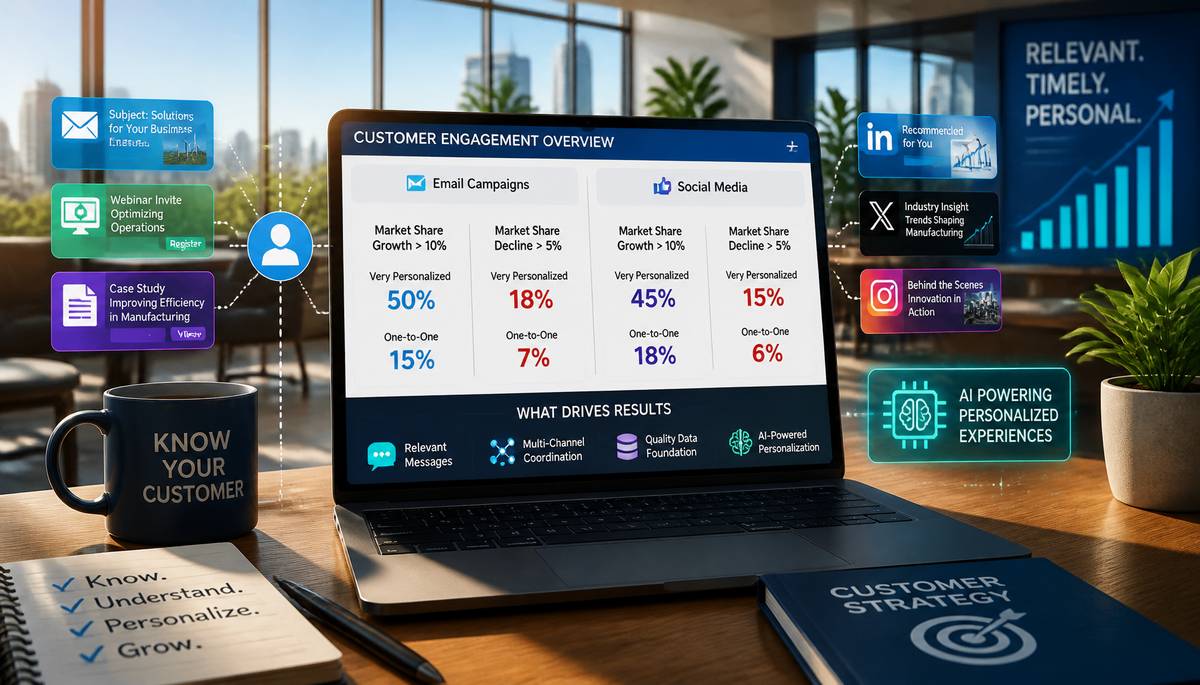 Personalization in B2B marketing is now so commonplace that the interesting question is no longer whether firms do it, but how far they can be bothered to go. McKinsey’s 2026 Global B2B Pulse Survey, drawing on decision-makers in 13 countries, suggests the firms pulling ahead are the ones practising it with almost indecent specificity.
Among companies that lifted market share by more than 10% year over year, half said their email work was very personalized, while 15% had reached one-to-one email personalization. On social media, 45% described their approach as very personalized and 18% as one-to-one.
The laggards looked distinctly less intimate. Of the companies whose market share fell by more than 5% year over year, just 18% reported very personalized email campaigns, and 7% managed one-to-one email. Social figures were weaker still: 15% said their strategy was very personalized, and 6% one-to-one.
The implication is plain enough. Buyers respond better when messages arrive with decent timing, some relevance, and a passing resemblance to their actual needs. Companies gaining ground are not merely tidying up one channel; they are coordinating several, which hints at competent teams and a customer strategy that survives contact with reality.
The catch is that hyperpersonalization demands sturdy customer data and workflows that do not collapse under their own ambition. AI may help with the drudgery: producing more content, scaling campaigns, and using zero- and first-party data without exhausting resources.
Posted on 7 June 2026
The Token Feast Meets the Reckoning
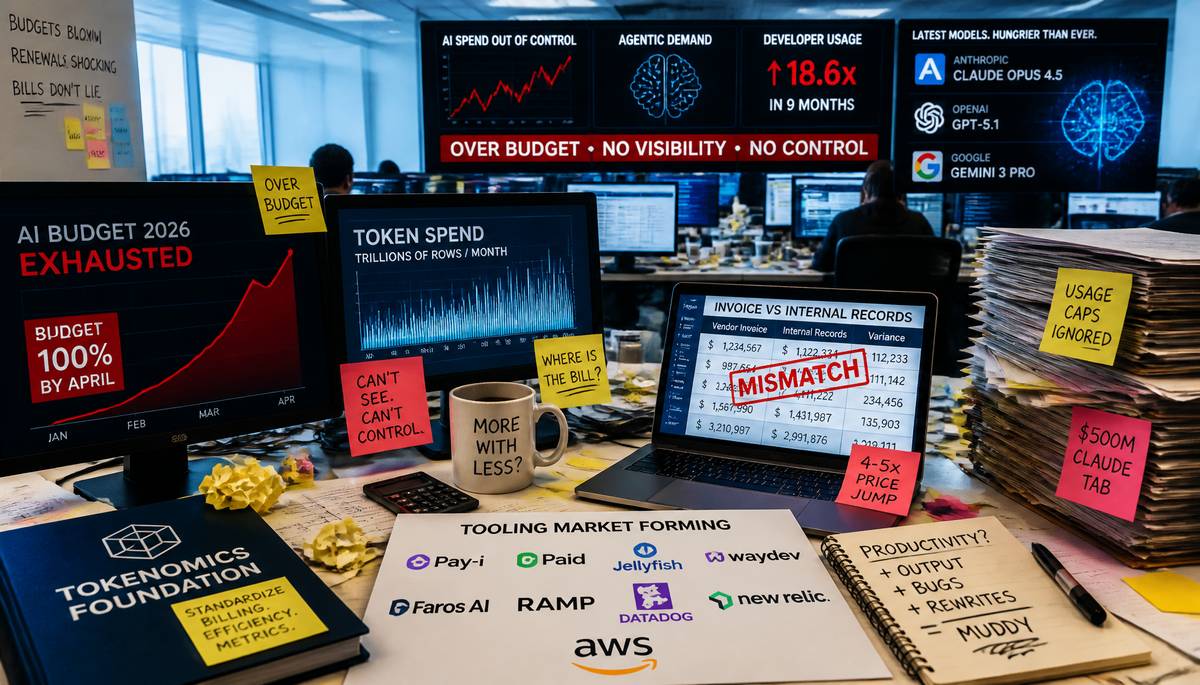 AI’s glamour phase is ending in the fluorescent back office, where the bill has begun to snarl. Uber exhausted its 2026 AI coding budget by April. Microsoft pulled developers’ Claude Code access only months after granting it. At Priceline, a routine Cursor renewal arrived priced roughly four to five times higher.
Cheaper tokens did not mean cheaper AI. Better models released in November — Anthropic’s Claude Opus 4.5, OpenAI’s GPT-5.1, and Google’s Gemini 3 Pro — made agentic software far more capable, and far hungrier. One company reportedly ran up a $500 million Claude tab after neglecting usage caps. By spring, some firms were already three times over their annual token budgets.
The problem is no longer whether the tools work, but whether anyone can see, audit, or control what they cost. Tracking token spend operates at trillions of rows per month, far beyond spreadsheet economics. Priceline is already finding mismatches between vendor invoices and internal records.
The productivity math is muddy. Faros AI’s two-year study of 20,000 developers found output rising alongside bugs and rewrites. Jellyfish found top AI users were about twice as productive, but consumed ten times more tokens; per-developer usage jumped about 18.6x in nine months.
Now a tooling market is forming — Pay-i, Paid, Jellyfish, Waydev, Faros AI, Ramp, Datadog, New Relic, and soon AWS. The Linux Foundation’s new Tokenomics Foundation aims to standardize token billing, efficiency, and metrics such as cost-per-intelligence and tokens-per-watt, but its first concrete output is still months away.
Posted on 6 June 2026
Filtr Turns Apple Privacy Into Something You Can Actually Feel
 Apple has spent years making privacy feel like a design preference. Filtr is what happens when that preference becomes infrastructural.
Built by Kaylee Serena Calderolla, the developer behind Wipr, Filtr uses a new URL filters capability in iOS 26 and macOS 26 to block ads beyond Safari, across iPhones, iPads, and Macs, at the network level. That matters because ordinary ad blockers mostly sanitize the web browser; apps have remained a separate, noisier reality.
Wipr already stops ads and tracking code in Safari. Filtr, sold as an added feature inside Wipr, extends that logic into apps, including non-Safari browsers. Wipr costs $5 on the App Store for all Apple devices. Filtr adds $5 per year or $25 for lifetime access.
Calderolla has described the implementation as difficult, partly because Apple’s documentation was thin. Filtr appears to be the first app using the feature. It relies on a maintained blocklist: a local pre-filter checks likely matches on-device, then confirms them against Calderolla’s servers. Those lookups pass through Apple’s proxy, obscuring the user’s identity. Calderolla’s privacy policy says her apps do not collect personal data.
The result is mostly invisible, which is the ideal state for privacy software. Ads disappear in many apps, sometimes leaving gray placeholders. It is not universal: Facebook, Google, Reddit, and other services that serve ads from their own domains can still slip through, because blocking the entire domain could break the app.
Posted on 5 June 2026
Microsoft’s Scout Turns OpenClaw Chaos Into a Corporate Assistant
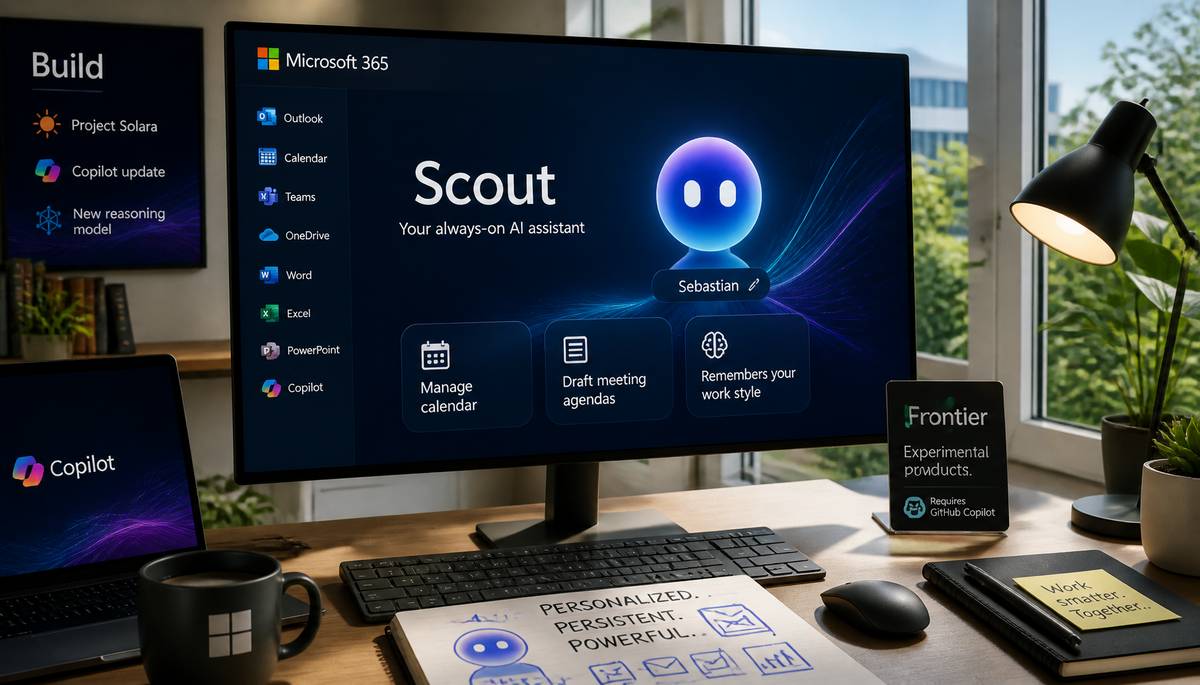 Microsoft is rolling out Scout, a new AI assistant for Microsoft 365 that takes a very OpenClaw kind of energy and tries to put it in a blazer.
OpenClaw tore through AI circles in early 2026, basically a feral genius of an agent framework. Its momentum cooled after OpenAI hired away its founder, but the idea clearly left fingerprints all over Microsoft’s latest move.
Scout, built on the OpenClaw framework, is an always-on assistant that keeps a persistent identity, style, and memory of how you work. Users give each instance a name; in one demo, it was Sebastian. The pitch is long-term adaptation: people feed it feedback, routines, and preferences, and over time it stores those patterns as durable memories and skills.
Access comes through Microsoft’s Frontier program for experimental products, and it requires a GitHub Copilot subscription.
The assistant runs from the cloud but reaches across desktop and browser environments, letting it connect with inboxes, calendars, and related tools. Microsoft will ship it with starter abilities like calendar management and meeting-agenda drafting, but the real strategy is user-built customization. That matters because once an assistant learns your weird little work habits, leaving it gets painful.
Microsoft is also wrapping Scout in stronger controls after OpenClaw exposed how badly autonomous agents can misbehave, including a reported inbox incident earlier this year. Scout includes a policy conformance system with continuous checks and audit trails.
Scout arrived alongside Project Solara, a Copilot update, and a new reasoning model at Build. Posted on 4 June 2026
AI Can Build the Stage, but B2B Websites Still Need a Human Plot
 AI and no-code website builders now whip up B2B sites at the speed of a glitter cannon. Platforms including Wix Harmony, HubSpot’s AI features and Relume can sketch sitemaps, layouts and draft copy in a matter of hours, shrinking a process that once lumbered on for weeks.
But speed is only the painted backdrop. The hard bit is still knowing who the site is for and how they buy.
GoingClear founder Paul J. Scott argues that AI is strong at producing a first pass, yet weak where B2B websites actually win or lose: understanding buyers, long sales cycles and the messy little rituals behind business decisions. A site that converts has to escort particular prospects through particular stages of a purchase journey. That requires context AI does not possess.
The real dividing line is strategy. AI can assemble a sitemap from a company description, but it cannot shape that structure around buyer intent, research findings or genuine customer anxieties. It can also generate familiar page layouts, though high-performing B2B sites need conversion-led experiences tuned to behaviour, not templates.
Branding suffers too. As more companies lean on machine-written copy, many sites blur into the same beige hum. When buyers are weighing major investments, they want authority, credibility and a distinct perspective.
As launching gets easier, advantage moves to whoever understands the customer best. Posted on 3 June 2026
b2blistings.org (c)2009 - 2026