How to Select the Best EMS Provider: a Strategic Decision Framework
Choosing the Right EMS Provider
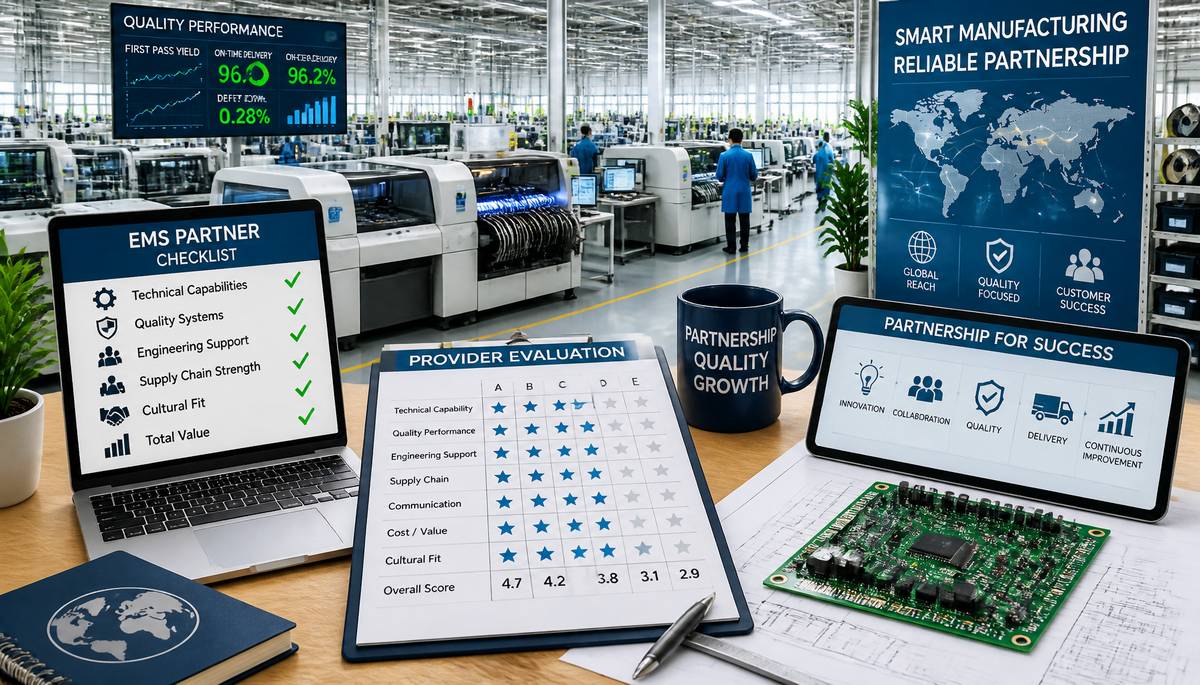
Choosing an electronics manufacturing services provider ranks among the most consequential decisions hardware companies make. This partnership affects product quality, time-to-market, production costs, supply chain resilience, intellectual property security, and ultimately customer satisfaction.
The consequences of poor EMS provider selection are severe: production delays that miss market windows, quality problems that damage brand reputation, cost overruns that destroy product economics, and supply chain failures that interrupt revenue. Conversely, the right manufacturing partner becomes a strategic asset that accelerates growth, enables innovation, and provides competitive advantage.
This comprehensive framework guides companies through systematic EMS provider evaluation, helping them identify partners aligned with their specific requirements, risk tolerance, and strategic objectives.
Understanding Your Requirements Before Evaluating Providers
Effective provider selection begins with clear self-assessment. Companies must articulate their requirements before meaningfully evaluating potential partners.
- Production volume profile: Annual unit volumes, batch sizes, and volume predictability determine which providers are appropriate. High-volume specialists struggle with prototype builds and small batches, while low-volume experts lack infrastructure for mass production.
- Technical complexity level: Simple assemblies differ fundamentally from complex boards with hundreds of components, fine-pitch BGAs, and multi-layer PCBs. Provider capabilities must match product complexity.
- Quality and regulatory requirements: Medical devices require ISO 13485 and regulatory compliance. Automotive electronics require IATF 16949. Aerospace applications demand AS9100. Industrial products may require ISO 9001.
- Business model preference: Turnkey manufacturing versus consignment assembly requires different operational capabilities.
- Geographic considerations: Manufacturing location affects shipping costs, lead times, time zone alignment, and supply chain resilience.
- Intellectual property sensitivity: Proprietary technology requires providers with robust IP protection practices and secure facilities.
- Timeline urgency: Aggressive time-to-market objectives require rapid NPI processes and responsive communication.
Building Your EMS Provider Shortlist
Once requirements are clearly defined, develop a shortlist of 5–8 providers for detailed evaluation. Too few limit options and negotiating leverage. Too many waste evaluation resources without adding value.
- Industry networks and referrals: Recommendations from colleagues and professional networks provide relevant starting points.
- Industry directories and databases: Specialized EMS industry resources allow searching by capabilities, certifications, and geography.
- Trade shows and conferences: Events like Productronica and APEX enable efficient provider comparison.
- Online research: Provider websites reveal certifications, equipment lists, and case studies, though claims require verification.
- Geographic targeting: Focus research on strategically relevant regions if location is a priority.
Critical Evaluation Criteria
Systematically evaluate shortlisted providers against criteria directly impacting partnership success.
Technical Capabilities
- Equipment and technology infrastructure: Modern SMT lines, AOI, X-ray inspection, and appropriate testing systems indicate capability for contemporary electronics assembly.
- Process certifications: IPC-A-610, IPC-J-STD-001, and relevant industry standards demonstrate technical competence.
- Complexity handling: Providers must accommodate your component sizes, board complexity, and assembly requirements.
- Volume flexibility: Capability should align with expected production volumes and variability.
Quality Management Systems
- Certifications and standards: ISO 9001 and sector-specific credentials provide structural assurance.
- Actual performance metrics: Review objective data such as defect rates, first-pass yield, return rates, and on-time delivery.
- Quality procedures: Well-documented inspection systems and process control methodologies indicate maturity.
- Traceability systems: The ability to link finished units to component lots and process parameters is essential in regulated or warranty-sensitive environments.
Engineering Support
- Design for Manufacturing capabilities: Strong DFM review processes prevent costly redesigns and delays.
- NPI processes: Structured New Product Introduction methodologies accelerate transition from development to production.
- Failure analysis: Rapid root cause identification and corrective action minimize disruption.
- Test development: Efficient test fixture design ensures appropriate quality verification without unnecessary cost.
Supply Chain StrengthFor turnkey arrangements, supply chain capabilities critically impact success.
- Component sourcing expertise: Experienced procurement teams navigate shortages and achieve competitive pricing.
- Distributor relationships: Strong franchised partnerships improve allocation priority and supply visibility.
- Inventory management: Proper storage conditions and tracking systems prevent degradation and obsolescence issues.
- Obsolescence management: Proactive lifecycle monitoring reduces long-term risk.
Making the Final Decision
After thorough evaluation, selecting an EMS provider requires balancing capability match, total value, risk exposure, cultural fit, and long-term strategic alignment.
The right partner is not merely the lowest-cost bidder, but the provider whose strengths align with your product, market, and growth trajectory.
Building a Successful Long-Term Partnership
Manufacturing relationships last years and influence every unit produced. Clear communication protocols, collaborative problem-solving, fair commercial terms, and continuous improvement expectations define successful long-term partnerships.
Conclusion
EMS provider selection should be treated as a strategic investment rather than a procurement shortcut. The time invested in structured evaluation pays dividends in product quality, supply chain stability, and long-term competitive advantage.
|
|

