What Emergency Locksmith Callouts Reveal About Business Operations
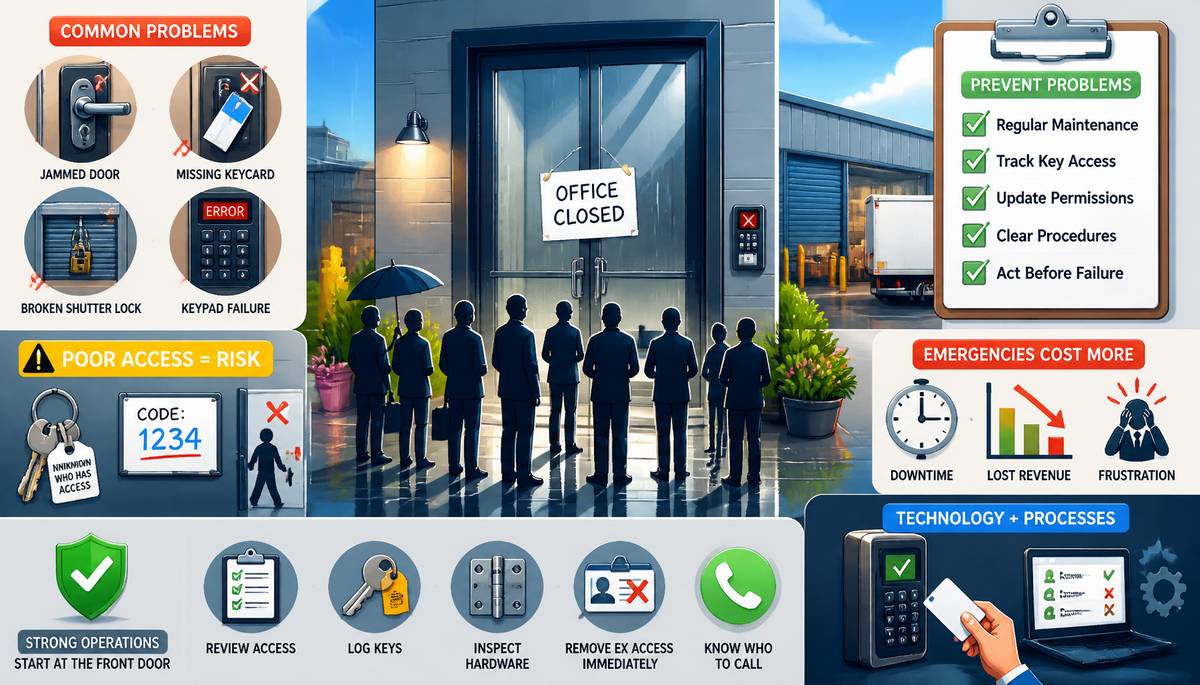 A jammed office door rarely appears on a quarterly risk report. Neither does a missing keycard, a broken shutter lock, or the warehouse manager standing outside in the rain because the keypad suddenly decided it had “retired from active duty.” Yet these small moments often reveal more about a company’s internal operations than a week of management meetings ever could.
Emergency locksmiths tend to see businesses at their least organised. Nobody calls one because everything is running smoothly. The phone rings when somebody is locked out, locked in, or glaring at a door handle with the kind of betrayal normally reserved for faulty printers.
Small Security Problems Usually Aren’t SmallOne failed lock can halt an entire working day. Staff wait outside. Deliveries pile up. Customers arrive to find handwritten apologies taped to the glass with whatever sticky tape survived the stationery cupboard purge.
What looks like a simple mechanical issue often exposes a wider operational problem underneath. Businesses that repeatedly deal with emergency lockouts usually share a few familiar habits:
- Keys are handed around casually with no tracking process
- Door hardware is ignored until it completely fails
- Staff access permissions are poorly managed
- Responsibility for physical security sits in a vague “somebody else handles it” category
A surprising number of businesses operate like a family household where nobody knows who borrowed the spare key last. Except in this case, the “household” includes thirty employees, a stockroom, customer data, and an insurance policy with several unpleasant conditions attached.
Deferred Maintenance Has Expensive TimingLocks and access systems rarely fail politely during quiet moments. They fail at 8:55am on a Monday morning or five minutes before an important client meeting.
Many companies treat door hardware as invisible infrastructure. If the key turns, nobody thinks about it. The slow warning signs get ignored for months:
- Stiff locks that require shoulder pressure and optimism
- Doors scraping against frames
- Buzzers that work “if you jiggle it a bit”
- Electronic entry systems that randomly forget authorised staff
Eventually, the entire system gives up with the dramatic flair of a theatre actor exiting stage left.
What makes this particularly costly is the domino effect. A broken lock may require an emergency callout, but the bigger expense often comes from lost working hours, delayed operations, frustrated customers, and overtime costs created by the disruption itself.
Facilities managers understand this well. Many smaller businesses do not. Preventative maintenance sounds boring right up until three employees are climbing through a side entrance because the main door has stopped cooperating with modern society.
Access Confusion Creates Quiet RiskPoor access control tends to grow slowly over time. One employee leaves but keeps their keys “for now.” Another staff member shares alarm codes with temporary contractors. Somebody writes the keypad entry number on a whiteboard because “everyone forgets it anyway.”
Months later, nobody fully understands who has access to what.
Emergency locksmith callouts often expose this confusion in spectacular fashion. A manager requests urgent lock changes after realising former employees still possess keys from two years ago. A business owner discovers six different versions of the alarm code circulating among staff like local gossip.
These situations create more than inconvenience. They create liability.
Insurance providers increasingly expect businesses to demonstrate reasonable security management. Missing master keys, undocumented access permissions, or outdated locks can complicate claims after theft or break-ins.
There is also the human side of operational confusion. Employees lose confidence quickly when basic systems fail repeatedly. Few things damage workplace morale faster than watching senior management argue over who last saw the warehouse keys while a delivery driver slowly ages in the background.
Emergency Situations Expose Communication GapsLocksmith emergencies reveal how businesses behave under pressure. Some organisations respond calmly with clear procedures and designated contacts. Others descend into a live-action experiment in collective uncertainty.
A common problem is the complete absence of ownership. Nobody knows:
- Who authorised the security system
- Where spare keys are stored
- Which contractor installed the locks
- What type of hardware is even fitted to the doors
This turns a thirty-minute repair into a three-hour scavenger hunt powered entirely by confusion and lukewarm coffee.
Businesses often invest heavily in cybersecurity while neglecting physical security basics. Yet operational disruption caused by access failures can be immediate and severe. Servers may be protected by sophisticated encryption, but none of it helps if staff cannot physically enter the building.
Operational Discipline Starts at the Front DoorStrong operational management is usually visible in surprisingly ordinary places. Well-maintained locks, controlled key access, updated entry systems, and documented procedures may not sound glamorous, but they reflect a business paying attention to detail.
Companies with fewer emergency locksmith incidents often follow consistent habits:- Access permissions are reviewed regularly
- Keys are logged properly
- Door hardware inspections are scheduled before failures happen
- Former employees lose access immediately
- Staff know exactly who to contact during security problems
None of this requires a futuristic security bunker with fingerprint scanners and dramatic blue lighting. Most problems disappear through basic organisation and routine maintenance. The challenge is that routine maintenance lacks excitement. Nobody gathers around the office kettle discussing hinge alignment with genuine enthusiasm.
Still, businesses that ignore physical security maintenance usually pay for it eventually. Sometimes literally at double rates during an out-of-hours emergency call.
Technology Does Not Automatically Fix DisorderElectronic access systems create efficiency when managed correctly. When managed badly, they simply produce faster confusion.
Many businesses install digital locks or smart entry systems expecting instant operational improvement. Then the practical reality begins. Cards stop working. Permissions are never updated. Staff share fobs like trading cards. Somebody forgets the admin password and writes it inside a desk drawer labelled “Important Stuff.”
Technology cannot compensate for poor internal processes. In fact, disorganisation becomes more obvious once digital systems start recording failures and access inconsistencies.
A surprising number of emergency callouts now involve electronic systems that were never maintained after installation. Software updates are ignored. Backup access methods are missing. Nobody trains staff properly because everybody assumes the system is “self-explanatory.”
Right until the office manager gets locked inside the building after closing time and discovers the emergency override instructions have vanished into history.
Locks, Keys, and Loose EndsBusiness disruptions rarely arrive with dramatic warning music. More often, they start with a stiff lock, an unreturned key, or a door that “has been acting funny for weeks.”
Emergency locksmith callouts provide a strange but revealing snapshot of operational health. They expose communication failures, neglected maintenance, weak accountability, and unclear procedures faster than many internal audits ever could.
Companies that treat physical security as part of everyday operational discipline tend to experience fewer emergencies, lower disruption costs, and far less panic standing outside locked buildings during working hours.
There is also something deeply motivating about avoiding the sentence, “Does anybody know where the spare key went?” because history suggests the answer is usually no.
|
|

