What a Commercial Floor Really Costs: Why Price per Square Metre Is the Wrong Number
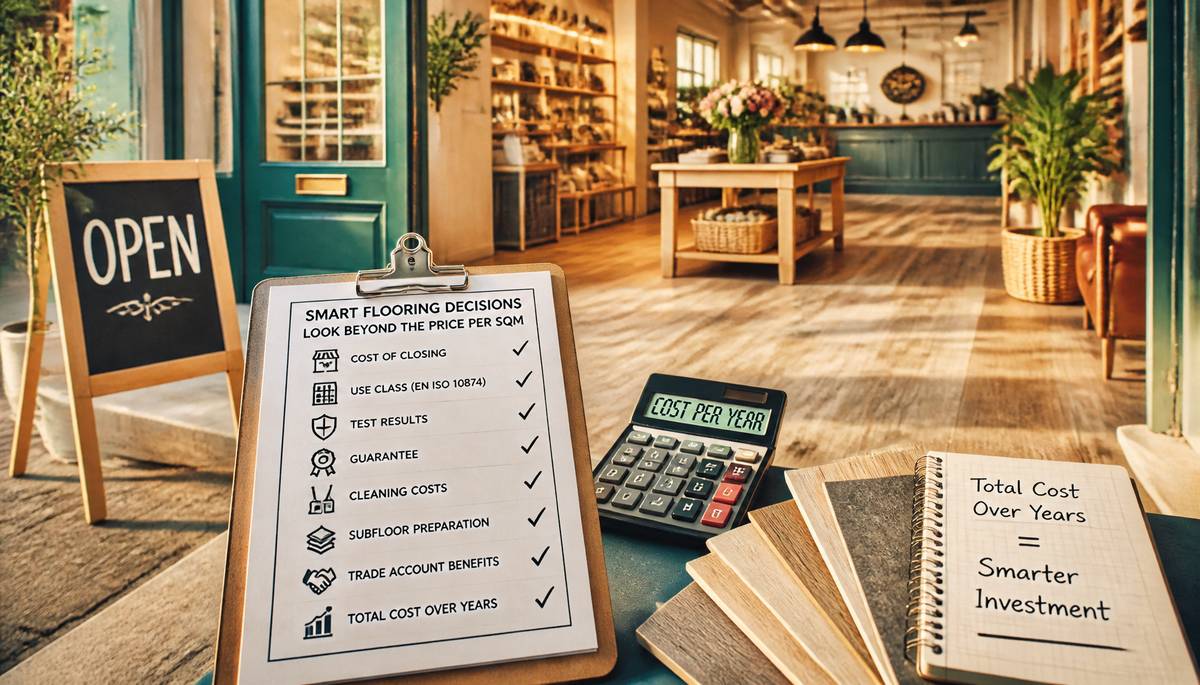 When a business fits out a shop, an office or a cafe, the floor is usually bought on one figure: the price per square metre. It is an easy number to compare, which is exactly why it misleads. The cost that matters is what the floor costs over the years it is in use, including the days the business has to close to fix or replace it.
Here is how to look at a commercial floor the way a finance director would.
Start with the cost of closing
A floor that fails early is not just the price of a new floor. It is the fitter's labour for a second time, the cost of moving stock and furniture, and the lost trade while the doors are shut. For a small shop or a salon, two days of closure can cost more than the flooring itself.
So the first question is not "what is the cheapest floor?" It is "which floor will let me trade without interruption for the length of my lease?"
Check the use class, not the sales description
Words like "heavy duty" and "commercial grade" mean nothing on their own. The figure to ask for is the use class under the European standard EN ISO 10874.
- Classes 21 to 23 are for homes.
- Classes 31 to 34 are for commercial spaces. Class 31 suits light use, such as a small office or hotel bedroom. Class 33 covers heavy commercial use, such as shops, open-plan offices, restaurants and school corridors.
If a supplier cannot tell you the use class, treat that as an answer in itself.
Ask for the test results your insurer may ask you for
Three results come up again and again in commercial fit-outs.
- Slip resistance. Look for a tested figure, not a claim. Two common ones are the R rating from the ramp test (DIN 51130), where R10 is a typical requirement for general commercial areas, and the DS classification under EN 13893.
- Fire rating. Floors are classified under EN 13501-1. A rating of Bfl-s1 is a strong result for a resilient floor and is often specified for escape routes and public areas.
- Castor chair test. If the floor is going under office chairs, check it has passed EN 425. Castors are one of the quickest ways to mark a floor that was not designed for them.
Keep the data sheet on file. If there is ever an accident or a claim, being able to produce the tested figures matters.
Understand the guarantee before you rely on it
Many floors advertise a long guarantee, but the headline term is often for homes. The commercial term is usually shorter. Ask for both figures in writing, and check what the guarantee expects of you, such as using the recommended adhesive and following the cleaning guidance.
Count the cleaning
A floor is cleaned hundreds of times a year. Over a five year lease that labour can cost more than the floor. Smooth, sealed surfaces such as luxury vinyl tile (LVT) need a sweep and a damp mop. They do not need polishing, sanding or periodic sealing. That is a large part of why LVT has replaced carpet tiles, laminate and timber in so many shops and offices.
Do not economise on the subfloor
Most commercial floor failures are not caused by the floor covering at all. They are caused by what is underneath: moisture in the concrete, an uneven base or the wrong adhesive. A moisture test and a proper levelling compound are a small part of the budget, and skipping them is the most common false economy in the trade.
Buy the way the trade buys
If you fit out more than one site, or you are a contractor buying for clients, it is worth opening a trade account rather than buying at retail each time. You get consistent pricing, one point of contact and a supplier who knows your specification. Some suppliers, such as Flooring Monster, offer trade accounts for flooring that are open to fitters, builders, landlords and businesses buying for their own premises.
A simple way to compare two quotes
Take each quote and add four things to it: the subfloor preparation, the fitting, the yearly cleaning cost multiplied by the years of your lease, and one closure if the floor is not rated for your level of traffic. Then divide by the years you expect the floor to last.
The floor with the lowest price per square metre is often not the floor with the lowest cost per year. That second number is the one worth buying on.
|
|

