Why Flexible Commercial Interiors Are Becoming a Financial Strategy Rather Than a Design Trend
 A fixed office can become outdated faster than the milk in the shared fridge.
Commercial interiors used to be judged mainly on how impressive they looked on opening day. Polished reception desk, smart meeting rooms, tasteful lighting, a kitchen area where someone would inevitably label their oat milk with military seriousness. Job done. But landlords, investors, and occupiers are increasingly looking beyond the first impression. They are asking a more financial question: how easily can this space change when the market does?Adaptability Has Become an Asset Flexible commercial interiors are no longer just about looking modern. They are about reducing risk. A space that can shift from open-plan workstations to private offices, from showroom to training area, or from single occupier to multi-tenant use has a wider pool of potential users.
That matters because vacancy is expensive. Every empty week means lost income, ongoing service costs, and the faint sound of spreadsheets sobbing in the background. A rigid layout may suit one very specific tenant perfectly, but if that tenant leaves, the next business may look at the same floorplan and see only demolition costs.
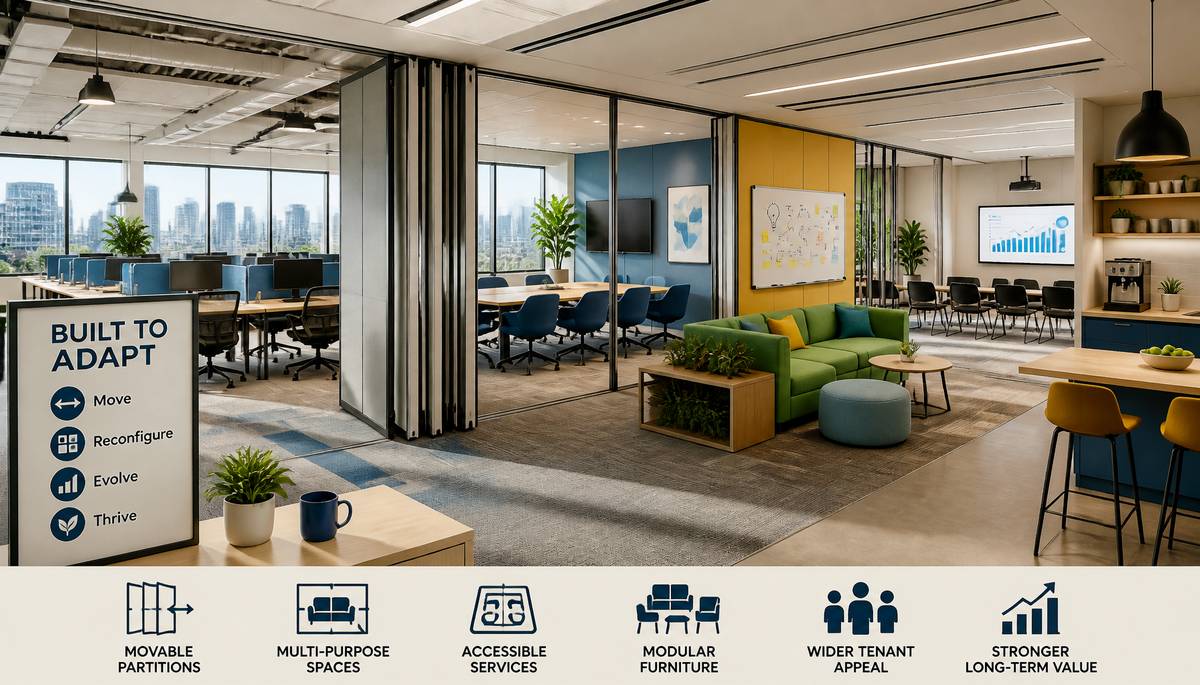
Adaptable interiors help avoid that problem. Modular partitions, movable walls, raised floors, accessible power routes, and multi-purpose rooms all make it easier to reconfigure space without starting again from scratch. The result is not just convenience. It is a stronger leasing proposition.Wider Appeal Means Shorter Gaps Between Tenants Commercial property markets change quickly. One year, demand may come from creative agencies wanting collaborative space. The next, it may come from professional services firms needing smaller offices, confidential meeting rooms, and somewhere to hide the printer before it develops opinions.
A flexible interior gives agents and landlords more ways to present the same property. Instead of saying, “This is what the space is,” they can say, “This is what the space could become.” That distinction can shorten vacancy periods because prospective tenants do not have to mentally bulldoze the entire fit-out before imagining themselves inside it.
For tenants, this also reduces hesitation. A business may be more willing to sign a lease if it knows the space can support growth, downsizing, hybrid working, or operational changes without a painful refurbishment every time the company chart gets rearranged.Future Fit-Out Costs Are Part of Today’s Decision The cheapest interior on day one is not always the cheapest over five or ten years. Fixed walls, bespoke joinery, and highly specific layouts can become expensive obstacles later. They may look beautiful, but so does a sports car until someone asks it to move a wardrobe.
Flexible design treats future alteration as inevitable rather than surprising. That shift in thinking is why adaptable interiors are becoming a financial strategy.
Modular Solutions Reduce Disruption
One of the biggest expenses during a commercial refurbishment is not always the materials. Lost productivity, delayed occupation, temporary relocation, and business interruption often cost far more than people expect.
Modular partitions and adaptable building systems help minimise those hidden costs. Instead of demolishing permanent walls, contractors can often relocate or replace sections with far less noise, dust, and downtime. Electrical and data services that have been designed with future changes in mind are also easier to extend without opening up half the building.
This flexibility benefits everyone involved. Building owners spend less on future alterations, tenants experience fewer operational disruptions, and contractors can complete projects more efficiently because they are modifying rather than rebuilding.
The approach also encourages businesses to make changes when they genuinely improve operations instead of delaying sensible decisions because refurbishment costs seem intimidating. That alone can improve productivity over the lifetime of a lease.Changing Markets Reward Flexible Thinking
Few property owners can confidently predict what commercial space will look like ten years from now. Hybrid working, technological advances, sustainability requirements, and changing business models continue to reshape expectations across almost every sector.
Designing interiors that can evolve alongside those shifts creates resilience. A floor that comfortably accommodates one large organisation today may need to support several smaller businesses tomorrow. A training suite might become collaborative workspace, while private offices may later transform into client meeting facilities or wellness areas.
Rather than chasing every workplace trend, adaptable interiors create a foundation that can absorb change without demanding complete reinvention. That protects capital expenditure while keeping buildings relevant for longer.
- Movable partitions allow rapid space reconfiguration.
- Multi-purpose rooms support different operational needs throughout the week.
- Accessible service routes simplify future electrical and network upgrades.
- Modular furniture systems reduce replacement costs during organisational changes.
- Flexible layouts appeal to a broader mix of prospective tenants.
Walls That Pay Their Way
Commercial interiors are increasingly being evaluated like any other long-term investment. Rather than asking how impressive a workplace looks after the ribbon has been cut, decision-makers are considering how many future problems today's design choices might quietly eliminate.
Adaptable layouts, modular construction, and multi-purpose spaces may require careful planning at the outset, but they often repay that investment through lower refurbishment costs, reduced vacancy periods, and stronger long-term market appeal. As economic conditions continue to shift, flexibility is becoming less of a fashionable design feature and more of a practical financial safeguard. Buildings that can change with their occupants are likely to remain valuable long after more rigid competitors begin showing their age. In commercial property, walls that are willing to move can sometimes help the balance sheet stand remarkably still.
|
|