When Everyone Started Using AI, Mechanical Turk Lost Its Reason To Exist
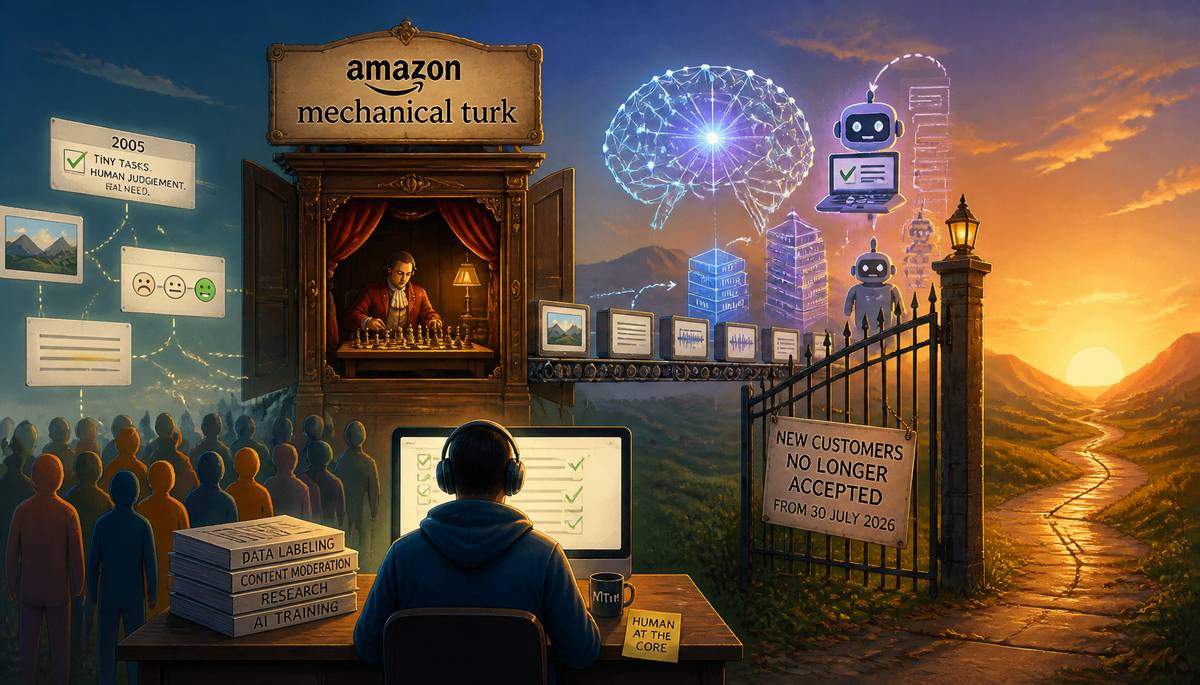
A slow ending foretold Amazon’s decision to stop accepting new customers for Mechanical Turk from 30 July 2026 feels less like a sudden death than the dimming of a lamp that had long been burning low. Existing customers will still be allowed to use the service, and Amazon Web Services says it will keep improving security and availability. Yet it has also made plain that no new features are coming. That is usually how a platform is told to prepare for its twilight: not with a trumpet blast, but with a quiet closing of the gate.
Mechanical Turk began in 2005 with a simple, almost cunning promise. It offered a market for tiny paid tasks that machines could not reliably manage on their own. A worker might solve a CAPTCHA, sort an image, or judge the sentiment of a line of text. These jobs were small, repetitive and often poorly paid, but they answered a real need in the early internet economy. Computers were fast, but there remained many little acts of judgement that still required a human eye and hand.
The hidden engine behind the machine For a time, Mechanical Turk became one of the best-known examples of crowd labour online. It sat at the heart of long arguments about pay, dignity and the ethics of fragmenting work into minute pieces. Its name was apt in more ways than one. The original Mechanical Turk, an 18th-century chess-playing automaton, was a fraud with a hidden human operator inside. Amazon’s version was no hoax, but it too relied on unseen people doing the work while the surface appearance suggested efficiency and automation.
That uneasy arrangement made the service useful far beyond simple tagging jobs. It was sometimes used as a backstage workforce for products advertised as far more automated than they truly were. In some cases, firms effectively placed people behind the curtain and let customers believe that software alone was doing the labour. Mechanical Turk also brushed against wider scandals of the tech age, including the early chain of events that fed into the Facebook-Cambridge Analytica affair. Its role was not central, but it was there, like a minor road joining a darker highway.
In 2018, Amazon tried to give the platform a new calling by linking it more closely to SageMaker. The pitch was clear enough: companies could use workers to label data for training neural systems. That move made sense for a while. Vast quantities of examples had to be sorted, classified and described before newer systems could be built. Mechanical Turk became, in effect, a workshop supplying the raw markings by which more advanced tools learned to recognise text, images and patterns.
When the workers changed the bargain But the bond between the platform and the systems it helped train did not remain stable. It curdled into something stranger. A 2023 analysis found that roughly a third to nearly half of the people completing tasks on Mechanical Turk were themselves using automated assistants to do the work. That was the turning point. Once the workers began handing part of the labour back to software, the old reason for the platform began to fail.
The problem was not only philosophical, though there is irony enough in it. It was practical. If customers came to Mechanical Turk because they wanted unmistakably human judgement, then widespread machine-assisted task completion cast doubt on the reliability of the output. Labels could become less trustworthy. Evaluations could become less distinct from the systems they were meant to supervise. And if software could complete so much of the work anyway, customers had reason to ask a harder question: why keep paying for a human marketplace in the middle?
That question seems to have grown heavier with time. After Amazon’s latest move became public, one Reddit user remarked that the service had effectively died years ago, abandoned by workers and researchers as bots and fraud spread across the platform. The comment may have been blunt, but it rings with the sort of weary recognition that often follows a long decline. Once confidence leaves a marketplace, it rarely returns by ceremony alone.
Mechanical Turk mattered because it exposed a truth the industry often preferred not to say aloud: many “automated” systems were built, checked and quietly sustained by human labour. Now it stands as a different kind of lesson. The same tools that once depended on armies of underpaid workers have become good enough that those workers can use them in return, blurring the line between person and process until the market itself loses its purpose.
Amazon has not yet pulled the final lever. The old machine still stands, and some customers still pass through its doors. But the age that made it necessary is fading. And when a service built to supply human judgement can no longer guarantee that what it sells is truly human, its end is not dramatic. It is simply, and almost sadly, logical.
|
|

